Product Overview
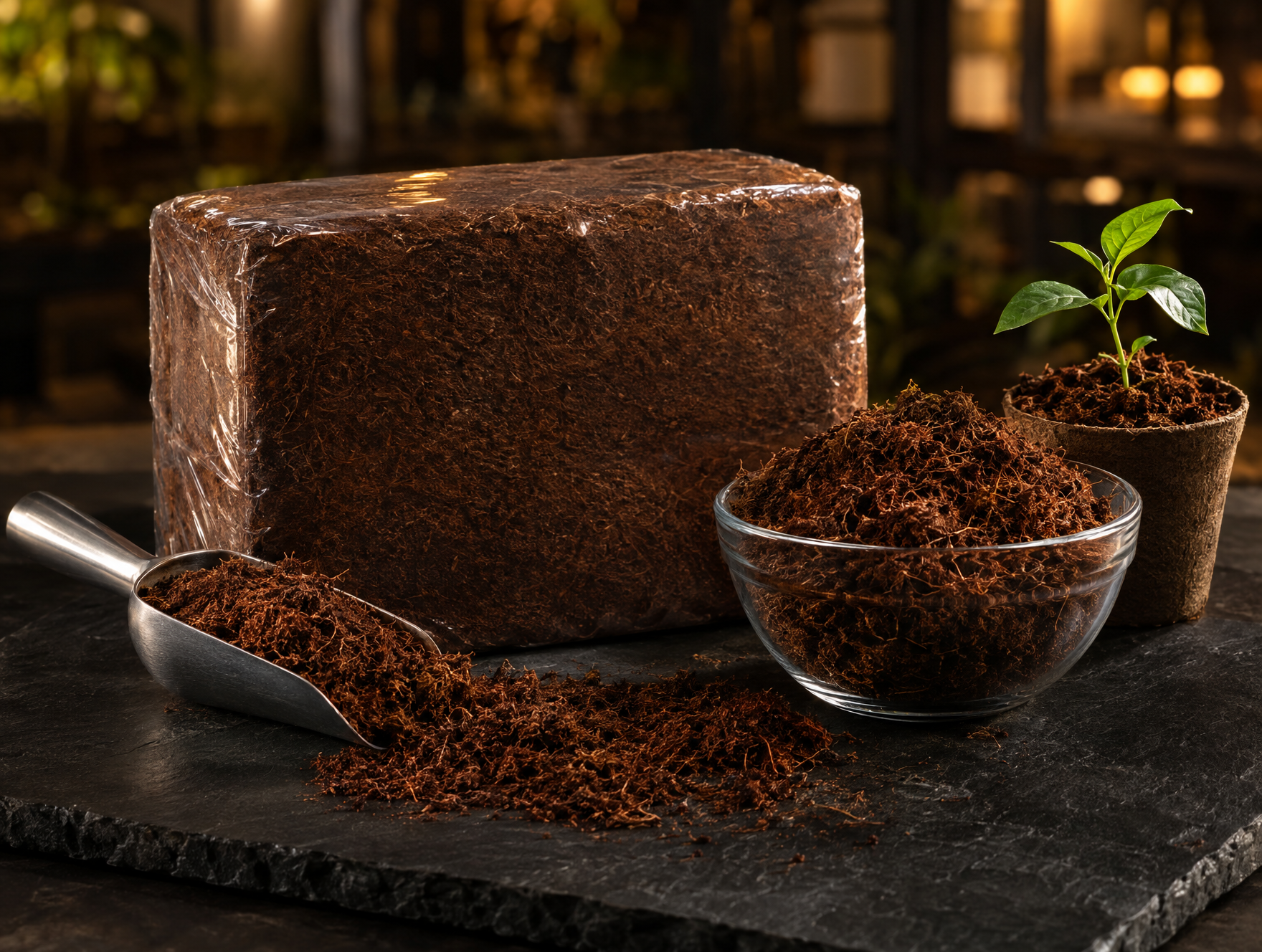
SS Global Commodities supplies Coco Coir Blocks (5kg), manufactured from natural coconut husk pith and triple-washed with fresh water for low electrical conductivity (EC < 0.7 mS/cm) and balanced pH (5.5–6.5). As a renewable alternative to traditional peat moss, compressed coco pith offers strong moisture retention, high cation exchange capacity (CEC) and good air-filled porosity for root aeration.
Designed for commercial horticultural growers, greenhouse hydroponic operations, potting-soil substrate manufacturers and retail garden supply chains, each 5kg compressed block expands to up to 75 litres of loose organic growing substrate when water is added. Blocks are palletised for containerised ocean export. Note: coco coir is supplied as a separate commercial commodity and is distinct from our animal-feed ingredient portfolio.
Key Product Advantages
- Peat-free & renewable: coco pith growing media made from natural coconut husk.
- Triple washed: low EC (< 0.7 mS/cm).
- Root-zone pH: 5.5 – 6.5.
- High expansion yield: up to 75 L per 5kg block.
- Screened particle size: 1–6 mm.
- Lot confirmation: specifications and lot analysis confirmed per shipment at quotation.
Coco Coir Block Technical Specifications
| Parameter / Test Item | Target Value / Range |
|---|
| Electrical Conductivity (EC) | < 0.7 mS/cm (triple washed) |
|---|
| pH | 5.5 – 6.5 |
|---|
| Particle Size | 1 – 6 mm (screened) |
|---|
| Block Weight & Size | 5 kg; 30 × 30 × 15 cm compressed |
|---|
| Expansion Yield | Up to 75 litres per 5kg block |
|---|
| Water Retention | Up to 8× dry weight |
|---|
| Organic Matter | > 90% |
|---|
* Values represent typical source-supplied specification ranges. Actual shipment lot analysis issued upon contract confirmation.
Palletisation & Export Logistics
| Item | Detail |
|---|
| Pallet Packing | 240 blocks per pallet (approx. 1,200 kg net at 5 kg per block) |
|---|
| Pallet Type | Heat-treated wooden pallets (ISPM 15), confirmed at quotation |
|---|
| Full Container Load (40ft HC) | Approx. 24 – 26 metric tonnes net (nominal, at 5 kg per block) |
|---|
| Pallets per 40ft HC | 20 – 22 pallets (4,800 – 5,280 blocks), subject to the container payload limit |
|---|
| Substrate Yield | Up to 18,000 litres per pallet (approx. 360,000 – 396,000 litres per 40ft HC) |
|---|
| Block Packaging | Shrink-wrapped with carry handles, or palletised with stretch film |
|---|
Hydration & Reconstitution Guide
1. Place the Block
Put the compressed 5kg block into a large container, wheelbarrow or mixing tub.
2. Add Water
Add approximately 20–25 litres of clean water.
3. Allow to Expand
Leave for 15–20 minutes while the block absorbs moisture and expands into up to 75 litres of loose, fluffy medium.
4. Break Up & Mix
Break up any remaining chunks and mix thoroughly before planting, or before blending with perlite, vermiculite or fertilisers.
Key Target Applications
- Commercial Greenhouses & Hydroponics: High drainage capacity and stable substrate structure for vegetables, berries and cut flowers.
- Potting Soil Mixes & Substrate Blenders: A peat substitute for formulating professional potting composts and container media.
- Seed Nurseries & Plant Propagation: Fine-screened texture promoting germination and root development.
- Horticulture & Floriculture: Retains water up to 8× its dry weight while keeping air-filled porosity.
- Lawn, Turf & Golf Course Maintenance: Organic soil amendment for aeration and moisture retention in sandy or degraded soils.
- Retail Garden Centres & Home Gardeners: Lightweight, compact block expanding to 75L for easy handling and storage.
Packaging, Storage & Handling
Packaging Options
5kg compressed blocks (30×30×15 cm), shrink-wrapped with handles or palletised with stretch film. 240 blocks per pallet; 20–22 pallets per 40ft HC container (final loading confirmed at quotation).
Storage Recommendations
Store in dry, covered warehouse conditions away from direct rain and prolonged water exposure to prevent premature expansion.
Notice: Product specifications and logistics details are confirmed per shipment lot. Pallet and container figures are nominal, calculated from 5 kg blocks. Export documentation requirements (for example phytosanitary or fumigation certificates) and lot-specific laboratory analysis are confirmed at quotation for your destination.